
In the News
2026 Hunter College
Undergraduate Research Conference
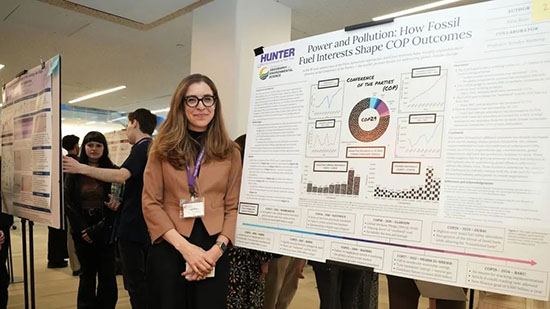
Students from the Hunter College Department of Geography and Environmental Science participated in the 2026 Undergraduate Research Conference (UGRC), presenting innovative research projects that explored the intersections of climate change, housing vulnerability, environmental resilience, and forest ecology. Held on May 1, 2026, the annual conference brought together undergraduate researchers from across the college to showcase scholarly and creative work spanning the arts, humanities, social sciences, natural sciences, and mathematics. Nearly 200 student researchers were selected to participate in this year’s conference, which also featured scholarly feedback sessions, a keynote address by Dr. Stanley Kerlicky, and a panel discussion on pursuing research opportunities.
Among the Geography and Environmental Science student presenters were:
Angelica Chicas
Property Value Changes, Housing Affordability, and Climate Risk in Mill Basin and Bergen Beach Before and After Hurricane Sandy
This project examines the influence of climate risk on property values and housing affordability in Brooklyn neighborhoods, Mill Basin and Bergen Beach, before and after Hurricane Sandy. Both neighborhoods were hit hard by Hurricane Sandy, revealing the underlying climate risks. The study aims to assess trends in financial pressures, property values, and housing costs related to climate vulnerability over time.
The project uses a GIS-based approach, focusing on spatial analysis to examine patterns from 2010 to 2022. NOAA has provided Hurricane Impact Zones and Flood Lines to serve as a baseline for environmental risk—MapPLUTO property data, paired with U.S. Census housing cost and evacuation zone clarification. ArcGIS Pro uses the combined data to provide maps that visualize spatial trends to compare neighborhood conditions before and after Hurricane Sandy.
General findings indicate that property values have risen since 2015, regardless of whether the property was flooded, including in Hurricane Evacuation Zones, even with wetland restoration efforts. Additionally, the cost burden on homeowners has increased for those who spend more than 30% of their income on home costs.
The study highlights the greater financial risk homeowners face due to rising property tax values and climate vulnerability. The gaps in climate adaptation within neighborhoods with housing affordability shape the long-term effects of resilience within the community.
Calista Lee
Assessing Fine Root Production at Climate Interactions with Forest Fragmentation (CLIFF)
Our forests sequester and store significant amounts of carbon from our atmosphere. Belowground net primary productivity (NPP) accounts for nearly 30% of total forest NPP; however, climate change and forest fragmentation may disrupt this sink. To better understand these disruptions, I investigated how the fine root biomass of different tree species differ in varying precipitation treatments and a forest edge to interior gradient at the Climate Interactions with Forest Fragmentation (CLIFF) experiment at Harvard Forest in Petersham, MA. I hypothesized that there will be no significant differences in tree species across precipitation treatment and a higher oak fine root biomass at the forest edge.
A total of 48 soil cores were collected during thesummer of 2025 at CLIFF. Soil cores were cut, placed in plastic bags, and stored in the freezer. To sort, soil was removed from the roots using various techniques, roots were picked out, quickly washed in deionized water, and then identified under the microscope. Sorted roots were placed into envelopes and into the freezer until it was rewashed. After, the roots were dried in the oven and weighed.
Based on previous data from CLIFF, expected results are that total fine root biomass will not change across the edge to interior gradient; however, a higher proportion of fine root biomass will be found deeper in the soil as oak root biomass increases in response to dry soil conditions in surface soils at the forest edge.
This work contributes to understanding how climate change and fragmentation work to alter forest belowground productivity of different tree species.


